Why Your Reforms Keep Failing: The Triangle We Ignore
Across governments, good ideas die not for lack of courage but for lack of wiring between Leaders, Institutions, and the Public. A simple triangle can show where reforms will break
Introduction
Public reforms fail far more often than they succeed. We tell ourselves these failures are about bad ministers or the wrong party. Most of the time, they are not. They happen because we treat change as a straight line from ‘big idea’ to ‘implementation’ when, in reality, it behaves like a triangle.
The more common story is simple: an idea appears, it gains attention, it is announced, sometimes it is even legislated, and then it stalls. The law is passed but never implemented. The programme is launched but never maintained. The movement rises but cannot build lasting structure. After a while, fatigue takes over and the Public becomes cynical. The reform becomes one more entry in the archive of “promises made, nothing changed.”
This piece argues that these failures are not random. Many reforms fail because they are built on an incomplete structure called the Triangular Framework for Meaningful and Lasting Public Change.
A brief history of the triangular idea
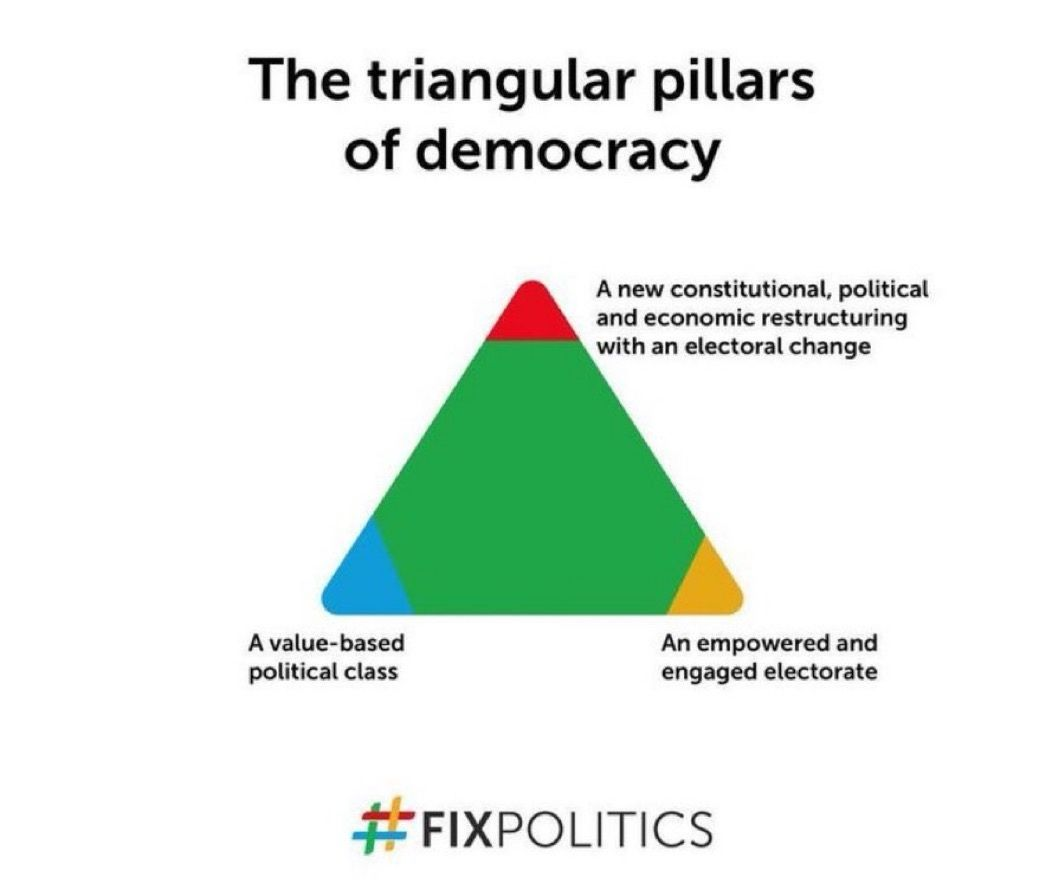
In 2020, Dr Oby Ezekwesili presented research developed during her time as a Richard von Weizsäcker Fellow on the relationship between the quality of politics and the economic performance of countries. From that work, she articulated what she called the triangular pillars of democracy. In her framing, the pillars are the electorate (the demand side), the politicians and political class (the supply side), and the regulatory, constitutional, legal, electoral, and Institutional context within which politics happens. She argued that the quality of outcomes depends on the relationship between these three pillars.
This logic became a foundational lens for the FixPolitics movement, a citizens-led movement focused on structurally changing and innovating politics in Nigeria, across Africa, and beyond.
What we do in this piece is expand the power of that triangular insight beyond electoral politics into the wider Public policy world. The triangle is not only a theory of democracy. It is a deeper observation about how durable change is built in Public life.
The core claim
Meaningful and lasting Public change does not emerge from single actors or linear processes. It emerges when three distinct but interdependent pillars are present, aligned, and mutually reinforcing.
In the FixPolitics language, the pillars are:
Leaders
Institutions
The electorate, or the Public
Where one pillar dominates, reform becomes brittle.
Where one pillar is missing, reform becomes unstable.
Where all three interact properly, reform gains durability.
This framework allows you to predict failure modes before they happen. It gives you a method for designing reforms that survive the messy reality of Public life.
What the three pillars actually do
To use this framework properly, you cannot treat the pillars as labels. You have to treat them as types of work. If the work is not being done, the pillar is not active, even if a named Institution exists on paper.
Pillar 1: Leaders
Their job is direction. Leaders do the “why” and “what” work.
They define the purpose, frame the problem, set goals, and draw red lines. They name what must not be compromised, and what trade-offs are acceptable. This includes elected Leaders, movement Leaders, policy entrepreneurs, and agenda setters. When Leaders fail at this work, reform will always drift, the goals shift with headlines, and implementation becomes reactive.
Pillar 2: Institutions
Their job is capacity. Institutions do the “how” work.
They translate the intent into systems and enforce rules consistently. They deliver repeatable action, not one-off miracles. When Institutions fail at this work, reforms will exist only as speeches and paperwork. Delivery becomes personality‑dependent and easily reversed.
Pillar 3: The electorate, or the Public
Their job is legitimacy. The Public does the “does this hold?” work.
They confer legitimacy or withdraw it, comply or resist. They defend Institutions or abandon them. Their lived experience determines whether a reform becomes normal life or becomes a dud. When the Public is excluded, reforms will face resistance, cynicism, and eventual collapse. Institutions lose the social backing needed to enforce rules fairly and Leaders lose the permission required to sustain long-term discipline.
The rule that makes the triangle real
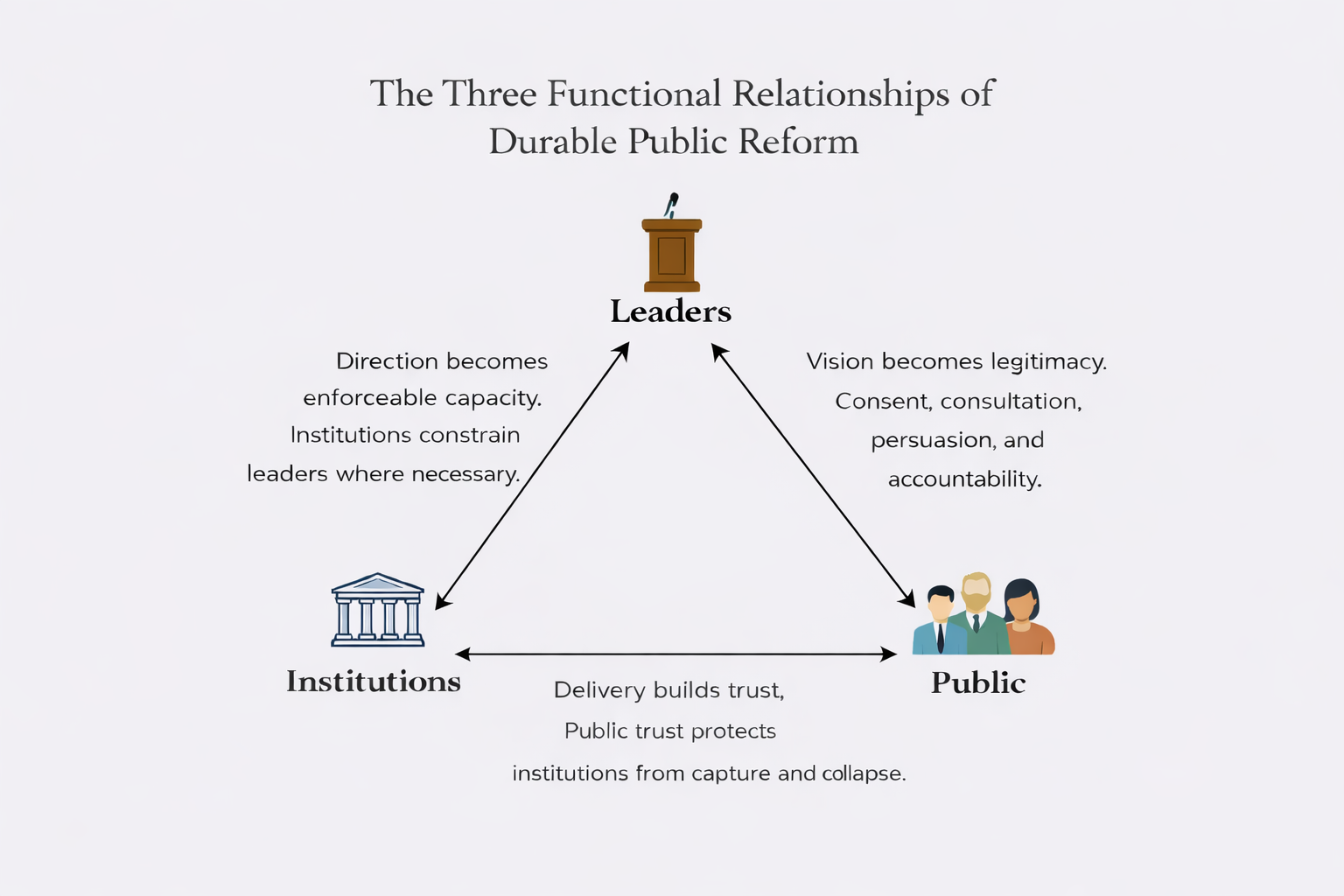
If you are using a triangular framework, you must account for all three bidirectional relationships. Otherwise, you will be describing a line, not a triangle. If any link becomes weak or one-way, failure is inevitable.
What happens when the triangle is unbalanced (failure modes)?
The absence or dominance of any pillar produces common failure modes:
Leaders without Institutions lead to ideology, moralism, drift, and slogans without delivery.
Institutions without Public legitimacy leads to technocracy, coercion, authoritarian tendencies, and brittle enforcement.
Public pressure without direction leads to populism, volatility, constant reversal, and short-termism.
When only two pillars interact strongly while the third is missing, additional dangers appear:
capture becomes likely
exclusion deepens
trust erodes
reforms oscillate rather than stabilise
The triangle is not decorative. It is the minimum viable complexity for durable Public change.
Case studies: the triangle in motion
Case study 1: Participatory budgeting in Porto Alegre
Leaders ↔ Public: Leaders opened structured channels for citizens to propose and prioritise spending. Citizens participated in assemblies and took ownership of trade-offs, which created legitimacy for the process.
Leaders ↔ Institutions: Political leaders not only invite participation; they formally embedded the process into municipal governance. They worked with the budget office and city departments to design rules, timelines, scoring systems, and weighting formulas that ensured poorer districts were fairly represented. Institutions, in turn, accepted this mandate and operationalised it. Civil servants translated citizen priorities into technically feasible projects and integrated them into the formal investment budget. Leaders provided direction and political protection. Institutions provided administrative discipline and continuity. This relationship ensured the reform moved from political promise to structured governance.
Institutions ↔ Public: Delivery was visible and reported back to communities, reinforcing trust and increasing participation, which then fed back into political support for sustaining the system. Participatory budgeting in Porto Alegre is widely documented as a process in which institutionalised citizen participation shaped budget priorities and created a reinforcing cycle between participation and delivery. The lesson here is structural: when citizen participation is not theatre, it can become a durable legitimacy engine that strengthens both Institutions and Leadership.
A current UK case: student loans and the triangle in breakdown
The UK student finance system is currently under visible Public pressure. The National Union of Students has publicly criticised the government, staging protests and using “loan shark” language against the Chancellor, Rachel Reeves, in response to repayment threshold freezes and ongoing interest concerns. All three pillars exist, but the relationships between them are strained.
What is missing right now
Leaders ↔ Public: Many graduates report that the system feels like a stealth tax, and that the original Public messaging did not match lived reality. When Leaders defend the system primarily with technical arguments or fiscal necessity, while the Public is experiencing anxiety and perceived unfairness, legitimacy erodes. In a triangle, Leaders do not only defend. Leaders also reframe, clarify trade-offs, and renew consent. If the only channel for Public feedback is outrage or protest, then the triangle is already failing.
Institutions ↔ Public: Operational Institutions such as the Student Loans Company and HMRC can enforce repayment through PAYE, but enforcement is not the same as legitimacy. Many borrowers do not receive simple, personalised explanations of likely lifetime repayments, likely write-off outcomes, and the effect of interest and threshold changes across different income paths. When the Public cannot easily understand the system that shapes decades of their life, trust degrades and misinformation fills the gap.
Leaders ↔ Institutions: The system contains Institutional expertise and long-run forecasts, including official student loan forecasts and parliamentary briefings. But the political system often reacts after pressure peaks, rather than embedding a predictable cycle of review and recalibration. In a functioning triangle, Institutional evidence does not only inform internal analysis. It forces clear political choices that can be explained to the Public. This piece is not arguing for one specific policy lever. It is arguing for a governance design that can sustain whichever policy settlement is chosen. At minimum, that means a regular public ‘settlement cycle’ on student finance, a duty for institutions to provide personalised lifetime‑repayment scenarios, and an independent advisory body that publishes scenarios before ministers tweak thresholds or interest.
Call to action: what the triangle asks of each pillar
If we want reforms that last, each pillar has a job.
Leaders: Stop treating Public backlash as noise. It is system feedback. Commit to re-consent, not just defence. Bind your own discretion through transparent rules, not just speeches.
Institutions: Treat legitimacy as part of delivery, not a separate communications task. Make the system explainable to ordinary people. Build interfaces where lived experience can shape redesign without crisis.
Electorate, and the wider Public: Shift from outrage-only participation to structured demand. Demand transparency, demand fairness, and demand predictable review mechanisms. Defend Institutions that behave fairly, and expose those that do not. The end goal is not simply to “win” an argument about student finance. The end goal is to build a system that is governable, explainable, adaptable and sustainable.
Conclusion
Public reform fails not because people lack ideas, courage, or intent, but because change is too often designed linearly rather than structurally. The triangular framework offers a way to see Public change as a design challenge. It forces us to ask: which pillar is missing, which relationship is broken, and what feedback loops are not functioning?
#FixPolitics and related efforts are not anomalies. They are expressions of a deeper truth:
Lasting change is rarely the product of one force acting alone. It is the result of Leaders, Institutions, and the electorate moving together in mutual, reinforcing relationships.
That is the central lesson of this piece. And it is also the invitation. Wherever you find yourself trying to change Public life, do not start by asking only what policy to implement. Start by asking what triangle you have built, and which link is already fraying. If we keep ignoring that triangle, we already know why our next round of reforms will fail.